

What do we have to do, huh? Bomb the Ferry
Building? Create an earthquake?

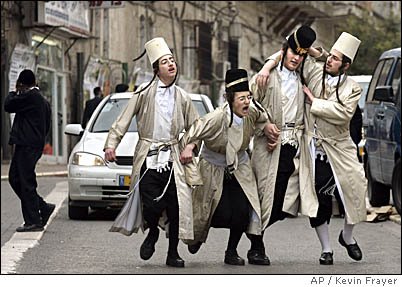 Ultra-orthodox Jewish men stagger down a Mea Shearim neighborhood street after ultra-heavy partying in Jerusalem. One of the precepts of the Purim holiday -- which commemorates the rescue of Jews from genocide in ancient Persia -- is excessive alcohol consumption.
Obama, as a Democrat, was raked over the coals for a similar remark:
"Americans are very frustrated, and they have every right to be," McCain said. "We've wasted a lot of our most precious treasure, which is American lives."
“[The Iraq war] should have never been authorized, and should have never been waged, and on which we've now spent $400 billion, and have seen over 3,000 lives of the bravest young Americans wasted.''
And so do we. It ends once America owns up to it.Two painful questions remain for all of us. Are the lives of Americans being killed in Iraq wasted? Are they dying in vain? President Bush says those who criticize staying the course are not honoring the dead. That is twisted logic: honor the fallen by killing another 2,000 troops in a broken policy?
I choose to honor our fallen hero by remembering who he was in life, not how he died. A picture of a smiling Augie in Iraq, sunglasses turned upside down, shows his essence -- a joyous kid who could use any prop to make others feel the same way.
Though it hurts, I believe that his death -- and that of the other Americans who have died in Iraq -- was a waste. They were wasted in a belief that democracy would grow simply by removing a dictator -- a careless misunderstanding of what democracy requires. They were wasted by not sending enough troops to do the job needed in the resulting occupation -- a careless disregard for professional military counsel.
But their deaths will not be in vain if Americans stop hiding behind flag-draped hero masks and stop whispering their opposition to this war. Until then, the lives of other sons, daughters, husbands, wives, fathers and mothers may be wasted as well.
This is very painful to acknowledge, and I have to live with it. So does President Bush.

Today, more than 270,000 soldiers stand guard in defense of freedom in over 120 countries.This is nothing new or shocking, but for some reason seeing U.S. military presence represented numerically this way--120/193 countries in the world--evokes the vast reach of empire decried by Chalmers Johnson. The Army advertises to sustain that presence (See "Why We Fight").


O.K., boys, party’s over: we’re leaving by Dec. 1. From now on, everyone pays retail for their politics. We will no longer play host to a war where we’re everyone’s protector and target. If you Sunnis want to go on resisting, we’ll leave you to the tender mercies of the Shiites, who vastly outnumber you. You Shiites, if you want to run Iraq without compromising with Sunnis, fine, but you’ll have to fight them alone and then risk having to live under the thumb of Iran.Mature foreign policy strategy--play vindictive martyr, blame the victim, collectively address all Arabs as children. He's right about a timetable and withdrawl--as a means for diplomatically leveraging support from regional powers. Unilateralism failed. By no means should withdrawal be used as a punitive measure against an already broken country.
You Saudis and other Arabs, if you don’t use your influence to delegitimize Sunni suicide bombers and press Iraq’s Sunnis to cut a deal, we won’t protect you from the consequences. And Iran, you win — yes, if we leave, you win the right to try to manage Iraq’s Shiites. Have a nice day.
A poll of 28,000 people in 27 countries has found most believe political and economic interests - not religious and cultural diversity - are the underlying cause of violent conflict in the world today.
Islam was singled out as a potential enemy civilization in an argument that was as deterministic as it was simplistic. Huntington's thesis dervied from established Orientalist thinking: "We are facing a mood and a movement far transcending the level of issues and policies and the governments that pursue them. This is no less than a clash of cilizations," wrote Beranard Lewis in 1990. "Islam has bloody borders," concluded Huntington.Bernard Lewis, Huntington's predecessor, originally coined the term. During a career spanning many decades of U.S. foreign policy blunders in the Middle East, Lewis fed (and, with a recent inflammatory WSJ editorial on Iran, continues to feed) the neoconservative movement a wealth of revisionist history that conveniently rationalizes their expansionist endeavors. Cheney commended Lewis as a scholar--"...in this new century, his wisdom is sought daily by policymakers, diplomats, fellow academics, and the news media." His aggressive ideology for governing the Islamic world is enshrined by the "Lewis Doctrine," which consists of "a Westernized polity, reconstituted and imposed from above...that is to become a bulwark of security for America and a model for the region." "Freedom" from without acts as a thin veil for securing strategic interests.
Bernard Lewis knows the greatness of Islamic civilization -- its tradition of learning and its towering cultural achievements. He refuses to condescend to the people that produced those achievements, and who have lately suffered such great torment at the hands of dictators.
Lewis' presentation of his narrative of Middle Eastern decline without any context is a ploy. His objective is to whittle down world history, to reduce it to a primordial contest between two historical adversaries, the West and Islam. This is historiography in the crusading mode, one that purports to resume the Crusades-interrupted in the thirteenth century-and carry them to their unfinished conclusion, the triumph of the West or, conversely, the humiliation and defeat of Middle Eastern Islam. Once this framework has been established, with its exclusive focus on a failing Islamic civilization, it is quite easy to cast the narrative of this decay as a uniquely Islamic phenomenon, which must then be explained in terms of specifically Islamic failures.
Once Western Europe began to make the transition from a feudal-agrarian to a capitalist-industrial society, starting in the sixteenth century, the millennial balance of power among the world's major civilizations shifted inexorably in favor of Western Europe. A society that was shifting to a capitalist-industrial base, capable of cumulative growth, commanded greater social power than slow-growing societies still operating on feudal-agrarian foundations. Under the circumstances, it was unlikely that non-Western societies could simultaneously alter the foundations of their societies while also fending off attacks from Western states whose social power was expanding at an ever-increasing rate. Even as these feudal-agrarian societies sought to reorganize their economies and institutions, Western onslaughts against them deepened, and this made their reorganization increasingly difficult. It is scarcely surprising that the growing asymmetry between the two sides eventually led to the eclipse, decline, or subjugation of nearly all non-Western societies.
College and high school students across the nation walked out class Thursday in a national student strike against the Iraq war. In California, an estimated 1,000 students at UC-Santa Barbara blocked traffic on a freeway. Up to 3,000 students turned out for an anti-war rally at UC - Berkeley. And at least four hundred rallied at Columbia University here in New York. More than a dozen other schools took part around the country.
You all were very helpful in making yesterday bigger than it would have been and I have to thank you for your brilliant energy, but the RCP seems intent on claiming this student led movement as their own. You people are great organizers, but I don't want the RCP taking credit for my political actions. And I definitely don't want RCP
trying to speak for me. I am not a communist and I have zero interest in Bob Avakian's political program. I am a student, a feminist, an antiracist and a little d democrat, and when I organize an action I want to speak about it and I want to represent it.
Ask yourself this; if the entire nation went on strike tomorrow – didn’t go to work or school and didn’t buy anything – how much longer do you think Bush’s war could last? I’d give it 24 hours or less. Striking alone here at UCSB might not mean much, but the world is watching. News of our strike is spreading across other campuses and cities. We will not be acting alone on the 15th. And if the 15th is empowering, perhaps there can be a real movement beyond this, a shift toward a larger national peace movement that joins us in withdrawing consent and shaking the foundations of power. The more of us that act together, the more hope there is that we can end the war.
It goes on one at a time,
it starts when you care
to act, it starts when you do
it again after they said no,
it starts when you say We
and know who you mean,
and each day
you mean one more.
Bush has two years left in office and enormous -- though not unlimited -- power to continue the war. He does not face re-election. Republicans in Congress do, however, and could brake Bush if they abandon him in large numbers.And away they go--11 Republican House members speak against Bush troop boost.
"Obviously the president still has a lot of muscle and is still doing what he wants, but the evidence is that this administration is starting to feel a bit checked," said Julian Zelizer, a Boston University historian who outlines congressional resistance during the Vietnam War in the March issue of the American Prospect.An effective system of checks and balances. Go figure.
Joseph Martz, leader of a team designing a new generation of warheads at the Los Alamos National Laboratory, said in a series of interviews last week that he is troubled by how the debate on nuclear weapons policy in Washington is focused narrowly on the number of weapons needed for the future, and how they would be built, rather than on how to eradicate them entirely.***Two widely-read opinion pieces published in the Wall Street Journal last month argued for total disarmament.The essays -- the first by former Secretary of State George Shultz, former Defense Secretary William Perry, former Secretary of State Henry Kissinger and former Sen. Sam Nunn of Georgia, and the second by the former Soviet leader, Mikhail Gorbachev -- urged aggressive steps toward this long ignored goal.
"Reassertion of the vision of a world free of nuclear weapons and practical measures toward achieving that goal would be, and would be perceived as, a bold initiative consistent with America's moral heritage," the former U.S. officials wrote in their essay.
“When the war is over, then there will be in all countries a pursuit of secret war preparations with technological means which will lead inevitably to preventative wars and to destruction even more terrible than the present destruction of life.”
Main Entry: anarchistDemonized and misunderstood (Chomsky identifies as an anarchist). Also interesting that "revolutionary" is a synonym. The Founders would be terrorists by this definition.
Part of Speech: noun
Definition: insurgent
Synonyms: agitator, insurgent, insurrectionist, malcontent, mutineer, nihilist, rebel, revolter, revolutionary, terrorist
Antonyms: loyalist
Main Entry: dictator
Part of Speech: noun
Definition: ruler
Synonyms: absolutist, adviser, autocrat, baron, boss, caesar, caliph, chief, commander, czar, despot, disciplinarian, duce, emir, fascist, kaiser, lama, leader, lord, magnate, martinet, master, mogul, oligarch, oppressor, overlord, rajah, ringleader, sachem, shah, sheik, slave driver, strongman, sultan, taskmaster, terrorist, tycoon, tyrant, usurper
Suprisingly suggests the suppressed notion of state directed terrorism.
Main Entry: enemyThe broadest possible definition, and the one we know all too well--you're with us, or you're against us.
Part of Speech: noun
Definition: foe
Synonyms: adversary, agent, antagonist, archenemy, asperser, assailant, assassin, attacker, backbiter, bad guy, bandit, betrayer, calumniator, competitor, contender, criminal, crip, defamer, defiler, detractor, disputant, emulator, falsifier, fifth column*, foe, guerrilla, informer, inquisitor, invader, meat, murderer, opponent, opposition, other side*, prosecutor, rebel, revolutionary, rival, saboteur, seditionist, slanderer, spy, terrorist, traducer, traitor, vilifier, villain
Antonyms: ally, benefactor, friend, supporter
Day after day, the egalitarian creed of our Declaration of Independence is trampled underfoot by hired experts and sloganeers, who speak of the "death tax," "the ownership society," "the culture of life," "the liberal assault on God and family," "compassionate conservatism," "weak on terrorism," "the end of history," "the clash of civilizations," "no child left behind." They have even managed to turn the escalation of a failed war into a "surge," as if it were a current of electricity through a wire, instead of blood spurting from the ruptured vein of a soldier.
My point here is obviously that at one time or another all of these things occurred and were (or still are) supported by people using the rhetoric that anyone who opposes it is aiding the enemy or being unpatriotic.
I used the word "terrorist" because that's the current name for the "bad guys". At various other times in history the "bad guys" were known as "Communists", "Socialists", "labor agitators", "Japanese Americans", "German Americans", "British", "Indians", "traitors" and a variety of other terms.
1984 - For years there was one phone company: AT&T. Then in 1984 the Justice Department forces AT&T to split up into a bunch of different companies. Seven of those become the regional Baby Bells (the regional Bell operating companies, or RBOCs), while what was left of AT&T handles long-distance.
The late 1990s - One of those regional local phone companies, Texas-based Southwestern Bell Corp, spends the late Nineties scooping up its fellow local phone companies, buying Pacific Telesis Group (PacBell) in 1997, Southern New England Telecommunications in 1998, and Ameritech in 1999. In 2002, SBC Communications, as it is now known, decides to ditch all the regional brand names and call the entire company simply "SBC" in order to "unify its image." SBC combines their cellphone operation with that of BellSouth in a joint venture known as Cingular Wireless. SBC owns 60% of Cingular. BellSouth owns the other 40%.
2001 - As part of a restructuring plan, AT&T decides to spin off their wireless division, known as AT&T Wireless, as a separate company.
at&T wireless logo
2004 - Cingular decides to acquire AT&T Wireless. Cost: $41 billion. AT&T, AT&T Wireless's former parent, retains rights to the AT&T Wireless brand name as part of 2001's spin-off agreement. They announce plans to launch a new wireless service under the AT&T Wireless brand name after Cingular completes its acquisition.
2005 - SBC, which you'll recall is an amalgam of regional Baby Bells spun off from AT&T, reaches an agreement to buy its former parent for $16 billion, $25 billion less than Cingular pays for AT&T Wireless. So SBC owns 60% of Cingular, which bought AT&T Wireless; assuming the Feds okay the deal, SBC will eventually own AT&T, too. Make sense?
Update: merger is approved in November, and SBC once again rebrands to AT&T. AT&T, which still has the rights to the AT&T Wireless name will begin using it in select markets, perhaps as a Cingular-based MVNO.
2006 - AT&T (formerly SBC) announces purchase of BellSouth for 67 billion dollars. Probably just to annoy us. We'll have to wait and see if the SEC approves.
"[Chai] will hit the roof," Bechar predicts. "The manufactured kind will continue to grow because Starbucks has already set the standard. But I don't think the homemade kind will grow as fast. We don't have the patience."-vs-
"My understanding is that Bechar has an old business model he likes to run, and we need to make upgrades,'' landlord Maher Shami said.Janfreya Didur, who works at kindred coffee shop MCoffee (my high school afternoon hang-out), says it best--
"I don't consider it progress to have more chains come in here - and Raman makes the best chai - the truth is in the taste."Shami underhandedly gave his application to bring in Peet's to the city council before talking to his leaser. Raman only found out when the mayor asked if he'd decided to close.

Funny, Schwarzenegger's campaigns have been dependent on dirty oil money too long as well. With a history of industry appointments, vetoes of environmental bills, and let's not forget the Hummers (put your money where your mouth is, gov), the Sierra Club has called his record a "shade of green"--not true blue.
Flexing His OPECs
Schwarzenegger, E.U. unveil new carbon-cutting schemesCalifornia Gov. Arnold Schwarzenegger (R) may be hobbled by a broken leg, but his mind is still strong. (File that under Sentences We Never Thought We'd Write.) In his State of the State address last week, the green-leaning Governator announced a plan to cut carbon in transportation fuel 10 percent by 2020. "Our cars have been running on dirty fuel too long. Our country has been dependent on foreign oil for too long. I ask you to set in motion the means to free ourselves from oil and from OPEC," he said. " California has the muscle to bring about such change. I say use it." The effort, hailed as an "innovative and exciting" world first, will likely mean ramping up ethanol and other renewables, and could cause a transitional increase in gasoline prices. Across the pond, European Commission President Jose Manuel Barroso unveiled a plan that would require member states to cut greenhouse-gas emissions 20 percent from 1990 levels by 2020. Oh, E.U., that is so 2006. Arnie's been there, capped that.

Our most urgent task is to proactively intervene to shape -- on behalf of progressive values -- the emerging commercial digital communications system. This will require a strategic intervention to create sustainable "new media" services that help harness the power of digital media to better promote social justice. Our digital media system will have the capability to help "define" political and social "reality" for the majority of Americans. Unless progressives can seriously "program" the new media -- in every community and across the nation -- we will face even greater obstacles promoting our agendas.Don Hazen, executive editor of AlterNet, concurs with Chester and Gillmore:
It is becoming increasingly clear that we need to focus more attention on the content and tools of the powerful new interactive digital landscape…and less attention on the delivery pipes. Here, huge media companies like Yahoo and Google are fighting that battle with us.I was happy to hear Bill Moyers reference this fact in his plenary address.
While net neutrality has an important goal of trying to protect us from future damage, it lacks the capability of fixing the myriad problems that already exist. And the company buyout that was approved in partial trade for net neutrality is an abomination, allowing AT&T, one of only three remaining regional phone companies from the original break up of AT&T back in 1984, to dominate 22 states, 67.5 million phone lines, 11.5 million broadband users.
"For them, essentially the way to handle the press is the same as how to handle the federal government; you starve the beast. When it's in a weakened and undernourished condition, then you're able to effect a variety of subtle partisan and political attacks."
What can they do
to you? Whatever they want.
They can set you up, they can
bust you, they can break
your fingers, they can
burn your brain with electricity,
blur you with drugs till you
can t walk, can’t remember, they can
take your child, wall up
your lover. They can do anything
you can’t blame them
from doing. How can you stop
them? Alone, you can fight,
you can refuse, you can
take what revenge you can
but they roll over you.
But two people fighting
back to back can cut through
a mob, a snake-dancing file
can break a cordon, an army
can meet an army.
Two people can keep each other
sane, can give support, conviction,
love, massage, hope, sex.
Three people are a delegation,
a committee, a wedge. With four
you can play bridge and start
an organization. With six
you can rent a whole house,
eat pie for dinner with no
seconds, and hold a fundraising party.
A dozen make a demonstration.
A hundred fill a hall.
A thousand have solidarity and your own newsletter;
ten thousand, power and your own paper;
a hundred thousand, your own media;
ten million, your own country.
It goes on one at a time,
it starts when you care
to act, it starts when you do
it again after they said no,
it starts when you say We
and know who you mean, and each
day you mean one more.
Iran's uranium enrichment program appears stalled despite tough talk from the Tehran leadership, leaving intelligence services guessing about why it has not made good on plans to press ahead with activities that the West fears could be used to make nuclear arms, diplomats said Thursday.
All of this intelligence that’s being done has uncovered a nuclear enrichment program, not a nuclear weapons program. But the Israelis have already concluded, thanks to Amos Gilad and his konseptsia, that a nuclear weapons program exists. Therefore, if you’re not finding evidence of it, it means you’re not looking in the right places. So then you begin to speculate. How many people here remember underground facilities in Iraq, Saddam’s tunnels, everything buried? Well, there weren’t, were there?
IAEA inspectors arrived at Natanz on Wednesday for a routine round of monitoring. But one of the diplomats said they were unlikely to find anything but the status quo — two small pilot plants assembled in 164-centrifuge "cascades" but working only sporadically to produce small quantities of non-weapons grade enriched uranium and other individual centrifuges undergoing mechanical testing. That has essentially been the situation at Natanz since late November, he said.Add that to a 2005 U.S. intelligence report that put Iran 10 years away from the bomb, and the manufactured hype becomes more obvious.
The International Atomic Energy group of the UN flatly contradicts a congressional report which talks about the danger of Iran’s nuclear weapons, and the international group, which has conducted many, many inspections in Iran, says, well, you know, you need to -- and they give the American people a kind of half-education. That is, they say, they use the phrase, “They’re enriching uranium.” Well, that scares me. You know, they’re enriching uranium. I don’t really know what it means, you see, but it’s scary. And then you read the report of the International Atomic Energy group, and you see, well, yes, they are. They’ve enriched uranium to the point of 3.5%. In order to have one nuclear weapon, they have to enrich it to 90%. They’re very, very far from even developing one nuclear weapon, but the phrase “enriched uranium” is repeated again and again.
"It's the low-hanging fruit of the health-care reform debate," said Dr. Bob Ross, president of the California Endowment, a private foundation in Los Angeles that was created to push for expanded access to health care.Now on the day before his address to the state, Schwarzenegger reveals his true colors:
"It's ironic that the governor is proposing healthcare for poor kids while taking away their breakfasts," state Senate leader Don Perata (D-Oakland) said of the cuts, which would affect more than 40,000 families. "Even Republican Gov. [Pete] Wilson, at the time he negotiated welfare reform, agreed that children should not suffer for the behavior of their parents."
So they can go to the doctor for a check-up, but they can't eat and they can't have a roof over their heads? I really don't get this. If this is "post-partisan cooperation", then I'm not particularly impressed.
A market-based system always puts increased revenues and profits over the health and well-being of those patients it is supposed to serve. As was the clear intent of a number of the free-market architects of the plan, it reinforces and expands the role of the market in health care, the very source of the present crisis. If the governor's goal is truly universal health coverage, improved quality and effective cost controls, the state should embark on the same tried-and-true course taken by every other industrialized nation, either a national health system, or a single-payer approach as embodied in the single-payer bill, SB840 authored by state Sen. Sheila Kuehl. Kuehl's bill was vetoed by the governor last year. It will be reintroduced this year.
The program, “Capital Campus California,” is sponsored by George Mason University’s Mercatus Center. (The Berkeley Center for Law, Business and the Economy as named as a co-sponsor, but the program isn’t mentioned on the UC website). Mercatus, which runs similar anti-regulatory sessions for Washington DC chiefs of staff, promises the weekend will provide “an academic perspective on today's pressing policy issues.”
Oil and gas giant Koch Industries gave Mercatus approximately $7 million between 1998 and 2004, according to the Wall Street Journal. ExxonMobil is also a Mercatus donor ($80,000 in 2003 and 2004), and other corporations with an interest in limiting regulatory protections, including General Motors, Pfizer, and even Enron, pre-collapse, are reported supporters.
Chong said she cares ''very much for consumers, particularly ones that are the most helpless.'' But she added that she has philosophical differences with consumer groups about how to deal with competitive markets.
She said her approach was ''trust, but verify. You hope that the market works, but if it doesn't, the PUC steps in.''
"We have decided to not take a more regulatory approach that was better suited to monopoly days and instead to trust the carriers to do the right thing given the market will demand it." --Chong, 3/30/06''If the marketplace was practicing as you're arguing (it is), there would not be a need for a... bill of rights,'' Senator Alex Padilla (D-Los Angeles) said. ''These problems would not be happening. The fact is, they are.''
"I believe that decision makers everywhere should step back from old style 'command and control' regulation and instead think 'regulatory light' where markets are competitive." --Chong, 10/26/06


