April 24, 2007

Read, read on.

most of all the world is a place where parts of wholes are described
within an overarching paradigm of clarity and accuracy
the context of which makes possible
an underlying sense of the way it all fits together

despite our collective tendency not to conceive of it as such
-
The Books, "Smells Like Content"

"Sample-folk" duo The Books performed at the Great American Music Hall last night.

Experimental violinist Todd Reynolds opened for them, his style what the NYT has described as "impassioned violin soliloquies." He used the same live track layering technique Zoe Keating does to create intricate soundscapes. One of the most memorable parts of his set was "Outerboroughs"--his soundtrack to filmmaker Bill Morrison's old edited public domain footage of a cable car going over the Brooklyn bridge. He recommended Morrison's nostalgic Decasia--old film being played for the last time while being burned into oblivion by a light projector.

When The Books took to the stage, Paul brought out what looked like the hollow shell of a cello--he dubbed it the "celleton." Gorgeous. And travel-friendly, too!

from Pitchfork

They did a cover of Nick Drake's "Cello Song," one of my favorites to along with play at home. The visuals were stunning--for a new song entitled "8 Frame" included in their newly released DVD Playall, the video was timed so each frame lasted for a quarter note. At the very end of the song, they did a gradual time lapse of a water balloon bursting into a thousand shimmering water droplets. Breathtaking. Their music and images are so meticulously coordinated that even the slightest hiccup in rhythm or intonation forces them to start a song over. At one point during "Smells like Content," Nick hit a flat, stopped, and apologized, explaining that if they kept going, everything would be off, and it would be "really bad." We were happy to oblige.

I think what's even more striking than their precision is their ability to create something that is at once provocative, innovative and still accessible, with universal emotional charge.

Pitchfork review writer Mark Richardson nails it:

...the Books have plucked sampled voices from their original context and arranged them inside simple compositions for sliced-and-diced guitar, banjo, and cello. They've taken moments of contemplation-- when one understands something on an emotional level but can't quite articulate his thoughts-- and dressed it up in a melodic frame
...
[It's] a fantastic reminder of the musicality of the spoken word, an idea that lurks constantly inside the music of the Books.
The Books' achieve this sound through their own wholly independent production:

We do all of our own sample collecting, composing, writing, recording, mixing, and mastering in our home studios using pc's running cheap software and the ragtag equipment that we've pieced together over the years. What you hear on our records is exactly how it left our hands, with no producer, engineers, or sweetening in between. We are completely independent, beholden to no corporations and we have funded all of our music entirely ourselves.
Some videos from last year's tour, at the University of Pennsylvania in Philadelphia:


Cello Song


An Owl With Knees


The Classy Penguin--about Nick's brother Mikey


"I want all of the American People to understand, that it is understandable that the American People cannot possibly understand."
--The Books, "An Animated Description of Mr. Maps"

April 19, 2007

Alternatives to sensationalism & scapegoating

Some significant dialogues that mainstream outlets have sidestepped in order to deliver their breathless, sensationalist coverage of the tragedy at Virginia Tech:

Let's not make this about race. Already Korean-Americans (or Asians in general since the many races are often lumped into one category), are anticipating the backlash to come. When teenagers shot up Columbine and when Timothy McVeigh bombed babies in Oklahoma City did we blame white males?

Does race play a role in all that goes down in this country? Of course. Discrimination, cultural values and norms, race is one of many things that contributes to who we are, the good and the bad. But there are actual substantive issues to deal with here, issues that don't lead us to easy, bigoted conclusions.
DKos: A Setback for the Blame Islam First Crowd


In the first hours after the Virginia Tech shooting, the internet was rife with frothing speculation about the "Asian connection" with Islamic jihad, as in the following typical instapinion:

First it was Johnny Muhammad, now it was Cho Sueng Hui aka Ismail Ax. Precisely how many mass shooters have to turn out to have adopted Muslim names before we get it? Islam has become the tribe of choice of those who hate American society.

Alas, the "tribe of choice" may have turned out to be ... well, let's just take a look at today's Bloomberg headlines:

Virginia Shooter Compared Himself to Christ in Video
By Nick Allen

April 19 (Bloomberg) -- The Virginia Tech university student who killed 32 people in modern America's worst mass shooting compared his own impending death to the crucifixion of Jesus Christ.

"I die like Jesus Christ, to inspire generations of the weak and defenseless people," Cho Seung Hui, 23, said during a rambling video message that he mailed to NBC News after killing his first two victims.

Somehow I don't think we're going to see a lot of speculation from the same sources in the coming days about whether Jesus Christ is a Rambo role model and Christianity is the "tribe of choice of those who hate American society."

Perhaps the dynamics of a tormented mind are little more complex than being reduced to a simple religious categorization, yes? Perhaps we can hope for a little more restraint – and information – before we leap to sweeping "evil doer" conclusions in the future?
(Note on breath: Don't hold.)

BoingBoing reader comments


I agree with BoingBoing reader Doyle's comments about predicting the religion of the shooter. Speculating him as Muslim, based on the finding of wording "Ismail AX", leans toward the islamophobic thoughts. The character Ismael belongs not only to a single but to various Abrahamic religions i.e. Judaism, Christianity, Islam, etc, and most of these religions predates Islam. More news is surfacing about the shooter's social interactions, which could lead to the fact that he was a psychotic, and may not have had much religious influence at all. Perhaps he just took the story of Abraham in a mythological way (even if it is remotely related). Has anyone thought or come up with a non religious explanation of 'Ismail AX'? It is amazing to see how people quickly connect anything bad with one religion. It's like they are looking for an excuse, not the answers.
And finally, Juan Cole provides some international perspective:

The profound sorrow and alarm produced in the American public by the horrific shootings at Virginia Tech should give us a baseline for what the Iraqis are actually living through. They have two Virginia Tech-style attacks every single day. Virginia Tech will be gone from the headlines and the air waves by next week this time in the US, though the families of the victims will grieve for a lifetime. But next Tuesday I will come out here and report to you that 64 Iraqis have been killed in political violence. And those will mainly be the ones killed by bombs and mortars. They are only 13% of the total; most Iraqis killed violently, perhaps 500 a day throughout the country if you count criminal and tribal violence, are just shot down. Shot down, like the college students and professors at Blacksburg. We Americans can so easily, with a shudder, imagine the college student trying to barricade himself behind a door against the armed madman without. But can we put ourselves in the place of Iraqi students?

April 09, 2007

UC's corporate bedfellows

From the LAT Blog--"Mixing Business with Government":

But now, there is more criticism over an agreement between the University of California and BP, the oil-producing giant. BP has committed to spending $500 million on alternative fuels research at UC Berkeley. Jennifer Washburn with the New America Foundation says it's a bad deal that "dispenses with numerous traditional safeguards designed to protect the university's independence. It grants BP unusual control over the institute's research agenda, makes no mention of peer review, downplays commercial conflicts of interest and contains provisions on publication that would violate UC's written policies."

"As such, the alliance would undermine the university's academic freedom, its ability to perform independent research and broadly disseminate results. And, possibly, it might undermine the public's trust. ... In short, for $500 million, the plan would allow BP, a company valued at $250 billion, to turn an academic research institute into its own profit-making subsidiary."

Schwarzenegger has done several events that have burnished BP's image as environmentally conscious. The UC agreement, announced by Schwarzenegger on Feb. 1, could provide a cautionary note as regulators begin implementing global warming legislation under AB 32. California business has a huge stake in the regulations, and just how embedded they become with government will be closely watched.

BP and Schwarzenegger are both experts at greenwashing their campaigns. But BP goes beyond the pale, doing far more environmental damage than good.

Using a respected institution like the UC as a fig leaf for its dubious projects is dangerous, blurring the divide between for-profit and public sectors. It's right up there with the UC's partnership with Bechtel to manage the nuclear weapons labs. The UC effectively lends corporations credibility and legitimacy in the public eye that they lack otherwise, and affords them greater latitude in their projects and less demand for accountability--it's all in the name of research and education, right?

Nuclear hype

A skeptical reading of Iran's announcement that it's expanding nuclear enrichment to reach "an industrial scale":

Michael Levi, a fellow for science and technology at the Council on Foreign Relations, was skeptical of the Iranian claims. He said by his calculations, the capabilities Iran has just announced would provide 10 percent of the material needed to run its plant.

"To me, that's not industrial scale," Levi said. "An industrial-scale facility is a facility that can support your industry."

On the other hand, "from a political perspective, it's more important to have them in place than to have them run properly," he explained since the announcement stirs up support and patriotism at home, and the international community has almost no way to verify how well the program is working.

"Iran looks to be moving its nuclear program along on a political schedule rather than a technical schedule," Levi said.

Levi marveled that Iran has the power to cause such a stir with an announcement. He noted that most of the time, world leaders complain they can't trust Iran, "except when they say something really scary, we take them at their word."

April 03, 2007

$4 a gallon

From Oil Watchdog:

Dow Jones Marketwatch online predicts today that U.S. gasoline prices could reach $4 a gallon. Bulletin: In San Francisco they already have, at some stations. Where are the politicians who should be screaming?
They're too busy kowtowing to the oil lobby, whose spending in CA has more than doubled in recent years, to the tune of $12 million during the 2005-2006 legislative session.

If there were any doubt about the quid pro quo relationship between politicians and oil money, here's a startling graph of gas prices over the last year in CA:

Our "no special-interest money" governor accepted $2 million in campaign contributions from Big Oil . After he called for an investigation of price-gouging at the pump this time last year, the Alliance for a Better California replied, "Arnold's latest slick stunt, pretending to care about soaring costs of gas prices, rings hollower than a Krispy Kreme doughnut.''

Campaign finance reform, anyone?

March 30, 2007

Understanding Iraq

The March/April issue of MotherJones features an article entitled Iraq 101 that offers a guide to Iraqi politics, a civil war FAQ, a breakdown of the costs, and predictions on the occupation's future ramifications.

The article provides a good crash course on the occupation itself, but obvious space limitations only permit a condensed history lesson summed up in a "5000 Years of Invasion" timeline. William Polk's "Understanding Iraq" provides a good survey of this history, framing current events in terms of the country's painful past.

Barry Lando's book "Web of Deceit: The History of Western Complicity in Iraq, from Churchill to Kennedy to George W. Bush" more closely examines 20th century Iraq in the context of Western imperialism. He surveyed this history on Democracy Now!:

AMY GOODMAN: I want to go back in time, Barry Lando, because you start the history of Western complicity in Iraq from Churchill to Kennedy to George W. Bush. Talk about how Iraq was formed, the current modern state of Iraq, and the central role of oil.

BARRY LANDO: Well, it was formed out of the collapsing Ottoman Empire at the end of World War I. The British and the French went in to kind of divide up much of the Ottoman Empire. And the British took essentially what is Iraq today. It was three provinces of the Ottoman Empire, and they put them together around 1920, ’21, into one country, which became known as Iraq.

These were peoples who had lived under the Ottoman Empire, but they had never been put together into one state, sort of living side-by-side politically and administratively. And it was a recipe for disaster. The British were warned about it at the time, but the reason they wanted to put these people -- the Shiites, the Sunnis, and particularly the Kurds -- in one place is the British wanted the petroleum, particularly the petroleum that the Kurds had. Kurdistan is a major petroleum area. They suspected -- they weren't pumping petroleum at the time, but they knew that it was there, and the British wanted that.

And they also wanted bases, too, in that part of the world, to protect their Persia, which was an important part of the British Empire, and India. So bases there became very important for them, too. So you had two things: petroleum and military bases, which are basically exactly the same motives, I think, that are keeping the United States in that part of the world today.

AMY GOODMAN: How did the US first get involved with Iraq?

BARRY LANDO: They came in as the British Empire was weakening, beginning to fall apart in the ’50s. The United States became active in that part of the world, and as the Cold War was going on, too, they looked at any attempts by leaders in that part of the world to become more independent from the West, to get more of their -- take more of their own petroleum resources for the benefit of their own country. To seek any kind of outside help from the Soviets, that became a sign that these people had to go. You had Eisenhower, Dulles, the CIA went in and overthrew leaders in that part of the world at that time.

AMY GOODMAN: John F. Kennedy and the CIA in Iraq?

BARRY LANDO: Well, before Kennedy, you had Eisenhower and Dulles, too, the overthrow of Mossadegh in 1953 in Iran. Then you had John Kennedy: in 1963, you had a nationalist ruler in Iraq, Qasim, and Kennedy's CIA and the Egyptians, who also didn't like him, joined together and they helped organize a coup in Iraq that overthrew Qasim. The Baath Party, which was -- Saddam Hussein was then a junior member of the Baath Party -- came into power.

They were -- the US liked them at the time. They were secular, strongly anti-communist, anti-Soviet. So they were seen as allies by the CIA. When they took over in 1963, the CIA supplied them with lists of suspected communists, militants, left-wing intellectuals, professionals, to be taken care of. They were picked up, tortured, and many of them were killed. We're talking about hundreds, maybe thousands, of people. Saddam Hussein then was one of the young torturers at that time.

AMY GOODMAN: And then, explain how he rose to power.

BARRY LANDO: Well, then, back in -- the Baath fell out of power again in 1968. There was another coup, and they came back in, and Saddam became the power behind the throne. It took him ten years to become formally head of Iraq, of the government in Iraq, but for most of that time he was already seen as the man behind the throne. He ran the secret police, and he used Stalinist methods to take over. He was a great admirer of Stalin. So in 1979, Saddam formally became the leader of Iraq.

AMY GOODMAN: President Carter's role here?

BARRY LANDO: Well, at this time, Khomeini had come to power in Iran, after the Shah was overthrown. Khomeini came to power. He was seen as an enemy of the United States, which he was. And you had the hostages taken. American hostages were taken from the embassy in Iran. And so, Carter did anything -- he wanted to do anything he could to weaken Khomeini. So did the other states of the Gulf. The Saudis, the Kuwaitis were terrified of Khomeini and what he could represent to their hold on that region, because Khomeini viewed them as dictators, and he was for the national -- taking over the oil, petroleum resources of those countries, as well, not for himself, but for the people of those countries. He represented a major threat.

Jimmy Carter encouraged Saddam, via the Saudis, to invade Iran. That started a war, which lasted for eight years, longest war of the 20th century, resulted in at least a million people dying on both sides. And, of course, the United States, other Western countries, Soviets, sold arms, continued to support the Iraqis during that period, and when it looked, though, that the Iraqis might win -- because they didn't want either side to win, really -- they also sold arms to the Iranians, as well. So the battle kind of went back and forth for eight years, with many countries selling arms to both sides. And the United States, in fact, even gave intelligence aid to both sides. And in the end, as I said, a million people died because of that war.

AMY GOODMAN: Gave intelligence on where Iranian soldiers were, to be gassed by Saddam Hussein.

BARRY LANDO: Exactly. The US gave satellite information, more to the Iraqis, enabling them to target Iranian troop concentrations, even though the US knew that the Iraqis were using chemical weapons.

AMY GOODMAN: Can you talk about the effect of the sanctions period, largely through President Clinton?

BARRY LANDO: Yeah, well, that started after Saddam had been thrown out of Kuwait. And you had -- an uprising took place, that was a whole other story.

AMY GOODMAN: Well, speak briefly about that uprising, because it's very significant for Iraqis’ view of the United States, too, and it involved President Bush, Sr.

BARRY LANDO: Yeah. To me, the uprising and what happened is really key, in a way, to what's going on there today. As Saddam had invaded Kuwait in August of 1990, and the United States moved in to push him out of Kuwait, when they did, George Bush called on the people of Iraq publicly, called on them to rise up and overthrow Saddam Hussein. This call was relayed by the CIA’s secret radio stations all over Iraq, and US airplanes also dropped millions of pamphlets over Iraq, telling the people of Iraq to rise up and overthrow Saddam. And they did. And the uprising spread like wildfire across southern Iraq. These were among the Shiites. The Kurds also rose up.

Then, the US, Bush Sr. and James Baker, became worried, because they realized they weren’t going to be able to control this uprising. They had wanted a military coup, a nice, neat military coup that in the end they could really control. But what, in fact, happened was a popular revolt. They were worried that perhaps Iran would come in, would try to make use of it; that the Kurds would try to set up an independent country that would disturb Turkey, their allies; that the Saudis wouldn’t like what was going on there. And so, they turned their back on the uprising.

They allowed Saddam to continue using his helicopters to attack the villages, and the Shiites had no way of fighting back against these helicopters. And when the Shiites came to American lines -- I spoke to a Special Forces officer who was just a few kilometers away from where the uprising was going on -- you had the Shiites coming to the American lines and saying, “Look, we're not asking you to fight for us. Just give us weapons. We will fight ourselves.” The Americans had hundreds of millions of dollars of arms that they had seized from the defeated Iraqi military. They destroyed those weapons, rather than turn them over to the rebels.

In another case, we were told that they blocked one rebel column from trying to march on Baghdad. They refused to meet with any of the insurgent leaders, who were desperately trying to talk to the Americans. The Americans refused to even talk to them, on the Kurdish side and on the Shiite side. So, finally, the revolt was over, and Saddam came in and killed, slaughtered, anywhere from 100,000 to 150,000 Shiites.

AlterNet is featuring an excerpt from Lando's book, in which he delivers a searing indictment of how Bush I encouraged, then betrayed the Iraqi intifada following the first Gulf War. Think Three Kings--without George Clooney leading the charge as America saves the day, helping the rebels triumph over the Republican Army.

From their base, Rocky and his units watched as Saddam's forces launched their counterattack against the rebel-held city. Thousands of people fled toward the American lines, said Gonzalez. "All of a sudden, as far as the eye could see on Highway Five, there was just a long line of vehicles, dump trucks, tractors -- any vehicle they could get -- coming to us in streams."

"The rebels wanted aid, they wanted medical treatment, and some of the individuals wanted us to give them weapons and ammunition so they could go and fight. One of the refugees was waving a leaflet that had been dropped by U.S. planes over Iraq. Those leaflets told them to rise up against the regime and free themselves."


If only we knew our history.

March 29, 2007

Arab League Summit

King Abdullah insisted at today's summit in Riyadh that "the 'real blame' for Arab woes lay with squabbling Arab rulers, who could only prevent 'foreign powers from drawing the region's future' if they united." However "unlike past summits that at times saw overt feuds break out, the gathering showed unusual public unity."


Arab leaders unite to reintroduce 2002 Beirut Declaration:

Under the plan, Arab nations would recognise Israel if Israel withdrew from land occupied in the 1967 war, accepted a Palestinian state, and agreed a "just solution to the Palestinian refugee problem".

Saudi monarch calls U.S. occupation illegal


"In beloved Iraq, blood is flowing between brothers, in the shadow of an illegitimate foreign occupation, and abhorrent sectarianism threatens a civil war," said the king.


Juan Cole's analysis:

King Abdullah followed up on these harsh criticisms of the US by cancelling his planned appearance at a White House dinner in April. The Saudi royal family is fit to be tied that Bush gave Iraq away to fundamentalist Shiite parties that have close ties to Iran.

Although the Saudi statement is remarkable for its brutal frankness and coldness toward the United States, its real significance is its slam of the government of Iraqi Prime Minister Nuri al-Maliki. Abdullah has not only said that the US presence is an illegal occupation, he has said that the al-Maliki government is nothing more than Shiite sectarian hegemony. The Saudis are known for their behind the scenes diplomacy and their public discretion. King Abdullah is hopping mad, to talk this way. It augurs ill for US-Saudi relations. Abdullah is also angry that Bush is letting the Palestine issue fester and that he pushed for open Palestinian elections but then cut off the Hamas government once it was elected. Abdullah thinks Bush is pursuing irrational policies, the effect of which is to destabilize the Middle East.

March 27, 2007

Breathtakingly stupid lede

Not so long ago, neighborhoods were defined by little things like race and class, religion and ethnic roots.

Now the measuring rod is something that really matters, at least in the Bay Area: what sort of coffeehouse takes root.

March 26, 2007

Objective reporting*

Writing on today's town hall meeting in Oakland, the Chronicle toes the Republican party line--"Dems don't have an alternate plan for Iraq":

Neither Penn nor Rep. Barbara Lee, the Oakland Democrat who has opposed the war since before it began four years ago, offered much in the way of specifics for ending the conflict, and they were largely preaching to the choir.
How easily these reporters turn a blind eye on comprehensive legislation provided by Lee, Boxer, and Waters in the Out of Iraq Caucus' Bring Our Troops Home & Sovereignty of Iraq Restoration Act.


*Not applicable to protest coverage

March 22, 2007

Blogger cred

Traditional journalists seem all too eager to malign blogger credibility. They'll jump at any opportunity, like Politico's mistaken headline this morning about Edwards suspending his campaign. But let's not forget that mainstream news isn't exactly infallible either (::cough:: Judith Miller, Jayson Blair ::cough::) and that their mistakes often have dire consequences.

At least this reporter from the Chronicle makes an important distinction--not all bloggers are created equal when it comes to responsible reporting:

In a blog entry headlined, "Getting it Wrong,'' Smith [of Politico] admitted the error.
"My source, and I, were wrong,'' Smith said.

But he wasn't the only one. The web site for Washington television station WYLT said that "CBS news is reporting . . . '' that Edwards is out and the popular internet site Drudge, made Edwards' suspension of campaigning his lead item.

But at least at first, there was no apology from Drudge for getting it wrong. Apparently, it is fine to grab a story from another source and run with it, as many did with Smith's report, but once it is wrong, he's on his own.

Surprise, surprise. This from the internet gossip made famous for breaking the Lewinsky scandal and for his libelous claim that White House assistant Sideny Blumenthal beat his wife. His latest desperate cry for attention involved claiming to have Gore stumped with global warming questions based on debunked science.

But Politico and Drudge are closer than one might think. Politico Editor-in-Chief John F. Harris paid homage to him in his book cowritten by ABC News political director Mark Halperin--a man who called Drudge the "Walter Cronkite of his era." The Way to Win: Taking the White House in 2008 includes a chapter entitled "How Matt Drudge Rules Our World." Let's hope they're wrong on that one.

March 21, 2007

Selling Israel

MoJo Blog looks at marketing Israel, in particular BlueStarPR's $17,000 ad campaign in the Bay Area.

I spotted their handywork on BART a couple weeks ago. My first thought--what about Al-Jazeera?

meloukhia also commented on this poster, noting that Israel was ranked 135 on the Freedom of Press Index 2006 by Reporters Sans Frontieres. Israel's extra-territorial behavior earned it such a dismal score.

Lebanon has fallen from 56th to 107th place in five years, as the country’s media continues to suffer from the region’s poisonous political atmosphere, with a series of bomb attacks in 2005 and Israeli military attacks this year. The Lebanese media - some of the freest and most experienced in the Arab world - desperately need peace and guarantees of security. The inability of the Palestinian Authority (134th) to maintain stability in its territories and the behaviour of Israel (135th) outside its borders seriously threaten freedom of expression in the Middle East.
According to its 2007 Annual Press Freedom Survey

Palestinian journalists faced many restrictions by the Israeli authorities, who considered them primarily as Palestinian citizens, and they were banned from travelling between Gaza and the West Bank for supposed security reasons. Israeli soldiers freely entered media offices and the homes of journalists in the Palestinian Territories looking for weapons and “illegal material.” Journalists of the pan-Arab satellite TV station Al-Jazeera were prevented several times from reporting on the war in Lebanon in mid-2006. Walid al-Omari, the station’s Jerusalem bureau chief, was arrested on 17 and 18 July while reporting in the north of the country. An Israeli military vehicle opened fire on another Al-Jazeera crew, led by journalist Jevara al-Budeiri, during live coverage of an Israeli incursion into Nablus and a technician,Wael Tantous, was hit on the foot by rubber bullets.

Israeli forces bombed Lebanese media installations during the fighting with the Hezbollah militia. Israeli warplanes destroyed a transmission mast at Fatka, east of Beirut, on 22 July, temporarily putting the privately-owned Lebanese Broadcasting Corporation (LBC) TV station off the air. A station technician, Sleiman Chidiac, was killed during the attack and two other employees injured. Israeli planes bombed an LBC installation in the northern town of Terbol the same day, cutting off broadcasts to some regions by LBC and privately-owned TV stations Future TV and Al-Manar.

Given these actions, it's no wonder Israel would feel the need to improve its image with a PR campaign.

March 20, 2007

Chicken little

From CIO magazine, the alarmist business perspective on California privacy legislation:

Like a large hurricane sweeping in off the Pacific, these laws will wreak havoc on all kinds of business processes, including how websites can collect personal data and the management of databases that store personal information on customers. They will influence how companies share personal data with third parties and restrict their ability to contact consumers via cell phones and faxes.
...
So what can CIOs do? You may not be able to divert this threatening tidal wave, but you can be prepared for it. To reduce your company's vulnerability, educate yourself about the legislation so that you can talk intelligently with your corporate counsel and CEO. And you can insulate yourself from some of the laws altogether by using encryption. Encryption is one solution to California's disclosure laws. Companies are not required to notify customers in the event of a security breach if customer data is encrypted.

Circumventing legal requirements is key, folks.

You can also adhere to best practices discovered by CIOs who have run afoul of some of these laws and learned from the experience. Such practices include communicating with the public on what information you collect, and following that up with clear, honest answers to questions from customers and the media in the event of an information leak.

Definitely haven't seen any evidence in my research of an effort on the part of telecommunications corporations to promote transparency and communicate with the public on information sharing.

The truth is that legislation hasn't gone far enough to hold business accountable in protecting sensitive consumer information.

American Jews to AIPAC: Not in our name.

Salon looks at how the 2nd most powerful lobby in Washington's strongest potential opponents are the people it purportedly represents:

The Bush administration's neoconservative Mideast policy is essentially indistinguishable from AIPAC's. And so it is no longer possible to ignore it -- even though it is a notoriously touchy and divisive subject. The touchiest aspect of all is the role played by pro-Israel neoconservatives in laying the groundwork for the Iraq war. Much of the media has been loath to go near this, for obvious and in some ways honorable reasons: It feels a little like "blame the Jews." But that taboo has faded as it has become clearer that "the Jews" are not the ones being blamed for helping pave the way to war, but a group of powerful neoconservatives, some but not all of them Jewish, who subscribe to the hard-right views of Israel's Likud Party. This group no more represents "the Jews" than the Shining Path represents "the Peruvians."
...
As a group, American Jews continue to be staunchly liberal. A new poll shows that 77 percent of American Jews now think that the Iraq war was a mistake, compared with 52 percent of all Americans. (Jewish support for the war has collapsed: A poll taken a month before the war showed that 56 percent of Jews supported it, somewhat below the national average at that time.) Eighty-seven percent of Jews voted Democratic in 2006. And although data here is murkier, polls also show that most American Jews hold views on the Israeli-Palestinian conflict that are to the left of AIPAC's.
...
The fact that AIPAC has anointed itself as the de facto spokesmen for American Jews is becoming more and more unacceptable. And increasing numbers of them are beginning to speak out.


Jews Against the War is a coalition of Jewish leaders doing just that.

March 15, 2007

Aptly named

Conquest Student Housing's idea of a good PR move on Facebook, following widespread student protest over last year's shameless profit-driven eviction of low income families in Isla Vista.

I guess the strategy is to deflect criticism with a distraction appealing to the lowest common denominator (obviously not below Conquest). A diversion that says "Hey kids! Over here! Sex!"--perfect.

Gentrification...you know you want it.

Banana boating the truth

Crooks and Liars traces tainted corporate contributions after today's news that Chiquita was being fined for paying right-wing terrorists in Colombia:
"Some of the same money that went to these terrorist organizations also went to the old Swift Boaters. Very interesting indeed...Remember - if you want to support terrorism then just give to the GOP. That will make sure you get off easy if you are busted supporting terrorist organizations."
Likewise, John Perkins explained in "Confessions of an Economic Hitman" how George Bush Sr.'s Zapata Oil purchased United Fruit. It's no secret how neoliberal politicians and corporations have plundered hand in hand in Latin America--it's a symbiosis in which one simply leads the way for the other, at the detriment of local livelihoods. No amount of presidential tours or photo-ops will change that reality.


h/t BoingBoing

Anti-war strategies from NPR

From All Things Considered--"Anti-War Groups Seek Breakthrough Moment"

Peter Overby's advice to peace activists:

"So if activists want to woo lawmakers, maybe occupying their offices isn’t the best way to do it. Maybe they should work inside the system and, say, offer to hold a fundraiser." --Peter Overby


Please tell me this is tongue in cheek.

Today the Senate rejected a timetable for withdrawal--after weeks of debating whether to have a debate--and the House is moving to pass its own bill (after striking a provision that would have given Congress more veto power in the event of an attack on Iran). I see little opportunity to work within that framework. The political will to goad lawmakers into action must come from outside the cautious Beltway.

For an NPR story that does less to marginalize anti-war activists, see Allison Keyes' "An Anti-War Movement in Search of Crowds." At least she incorporated more voices than just MoveOn.

March 09, 2007

Red Cross scare tactics


via Boing Boing


What do we have to do, huh? Bomb the Ferry
Building? Create an earthquake?

March 06, 2007

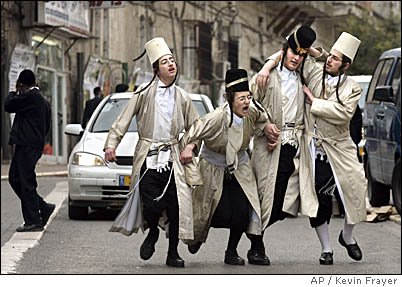
"[Stumbling] Home for Purim"

Oh, SF Gate DIP and its fakakta captions:

Ultra-orthodox Jewish men stagger down a Mea Shearim neighborhood street after ultra-heavy partying in Jerusalem. One of the precepts of the Purim holiday -- which commemorates the rescue of Jews from genocide in ancient Persia -- is excessive alcohol consumption.

March 01, 2007

Our "wasted treasure"

McCain "stumbles out of the gate," perhaps unintentionally delivering one of the most candid and meaningful comments to come out of the "Straight Talk Express."

"Americans are very frustrated, and they have every right to be," McCain said. "We've wasted a lot of our most precious treasure, which is American lives."
Obama, as a Democrat, was raked over the coals for a similar remark:

“[The Iraq war] should have never been authorized, and should have never been waged, and on which we've now spent $400 billion, and have seen over 3,000 lives of the bravest young Americans wasted.''

If McCain were a principled candidate (and he's not), and truly disapproved of Bush's handling of the war (he voted for it, before he...didn't show up to vote against it), he should have stuck by the remark. That goes for Obama, too--especially running on an ostensibly antiwar platform (minus his suggestion to increase defense spending post-withdrawal).

One simply cannot simultaneously advocate withdrawal on the grounds that the invasion was illegal, the "mission" ill-defined, and the occupation a bloody disaster and still defend the notion that such a debacle somehow warranted the loss of thousands of lives. If you believe the war is unjustified, a cause not worthy of death, then the sacrifices made in prolonging it are also tragically unjust.

Those demanding apologies from Obama and McCain lambast their remarks as callous and unsympathetic of the grieving families and friends of soldiers killed. But it's Gold Star family members, in the tradition of Cindy Sheehan, that make the most compelling arguments for calling it like it is--no matter how heart-renching that realization may be--if it will prevent the senseless loss of one more life :

Two painful questions remain for all of us. Are the lives of Americans being killed in Iraq wasted? Are they dying in vain? President Bush says those who criticize staying the course are not honoring the dead. That is twisted logic: honor the fallen by killing another 2,000 troops in a broken policy?

I choose to honor our fallen hero by remembering who he was in life, not how he died. A picture of a smiling Augie in Iraq, sunglasses turned upside down, shows his essence -- a joyous kid who could use any prop to make others feel the same way.

Though it hurts, I believe that his death -- and that of the other Americans who have died in Iraq -- was a waste. They were wasted in a belief that democracy would grow simply by removing a dictator -- a careless misunderstanding of what democracy requires. They were wasted by not sending enough troops to do the job needed in the resulting occupation -- a careless disregard for professional military counsel.

But their deaths will not be in vain if Americans stop hiding behind flag-draped hero masks and stop whispering their opposition to this war. Until then, the lives of other sons, daughters, husbands, wives, fathers and mothers may be wasted as well.

This is very painful to acknowledge, and I have to live with it. So does President Bush.

And so do we. It ends once America owns up to it.